Distributed show control that always points home.
Northstar is a turnkey, offline-first show control system for haunted attractions, escape rooms, museums, and immersive theater. Mission-critical hardware. No cloud. No subscriptions. Hardware you can hold, software you can see, a network you control.
Five layers. One system.
Every Northstar install runs the same five layers — a Helm server, a TrueNorth network, a Bridge operator panel, a fleet of Polaris field nodes, and the Compose show designer that ties them together. Mix and match the node count; the rest of the stack stays the same.
Helm Server
The brain. Runs HelmOS, polls the fleet, fires every cue.
Polaris A
Two channels of triggered audio. Drop in, power up, fire.
Bridge Operator Panel
Physical buttons. Real interlocks. No mouse required.
TrueNorth Network
Your show network. Isolated. Air-gapped. Yours.
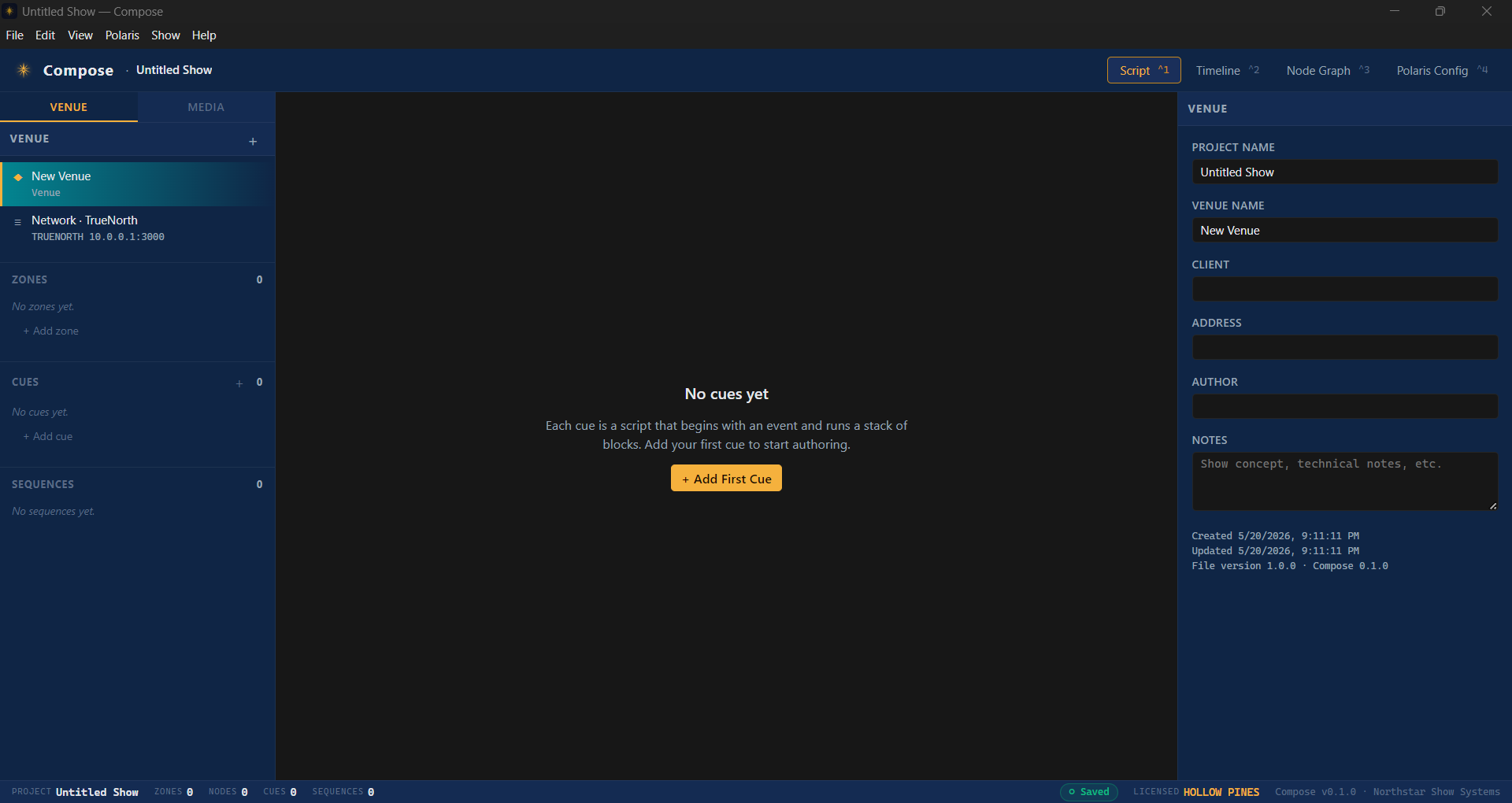
Compose Show Designer
Visual show design. Offline. No programming.
From button press
to trigger fire,
in 15 milliseconds.
The full path of a Show Start, end to end. Numbers below are measured on a stock Standard package with five Polaris nodes on a single TrueNorth AP — no marketing math.
- +0 msBRIDGEOperator presses SHOW START
Bridge fires a serial frame to Helm over USB. The button LED latches green; the latch is hardware, not software.
- +5 msHELMOSShow state transitions to RUNNING
HelmOS validates interlocks (Stop not latched, Maintenance key out), writes the state change to disk, and queues cue 1 of the show sequence.
- +8 msTRUENORTHCue dispatched over Wi-Fi
Helm issues parallel HTTP GETs to every node in the cue's target group on 10.0.0.0/24. WPA2-PSK overhead is amortized; the link is already up.
- +12 msPOLARISTrigger pulse fires
Each Polaris node receives /trigger?ch=N, pulses the GPIO line (LOW or HIGH per node type), and returns a JSON ACK to Helm.
- +15 msCUEMASTEROperator dashboard updates
Cuemaster, running full-screen on the Helm host, updates instantly. The cue row turns gold; the activity log appends the trigger.
Cue 1 of N — live
Built for venues that open at dusk and don't close until midnight.
Northstar is in the field at haunted attractions, escape rooms, museums, and immersive theater productions. The hardware is the same; the cue lists are different.
Haunted Attractions
60–200 GPIO channelsScare triggers, prop activation, lighting, ambient audio across dozens of rooms — fired on schedule, on cue, or on actor input.
USE CASES →Escape Rooms
8–24 GPIO channelsPuzzle-triggered effects, game-flow sequences, multi-room coordination — locks, magnets, reveal mechanisms, hint audio.
USE CASES →Museums & Exhibits
10–60 channels per galleryScheduled playback, interactive triggers, timed exhibit sequences — runs unattended for hours.
USE CASES →Immersive Theater
40–150 channels per productionMulti-zone show control for walk-through and site-specific performances — millisecond cueing across buildings.
USE CASES →A 50-device system across 3 buildings: $2,500 – $3,500 total BOM.
That's under a tenth of what an equivalent commercial system costs — and you own every line item, every byte of show data, and every spare on the shelf.